
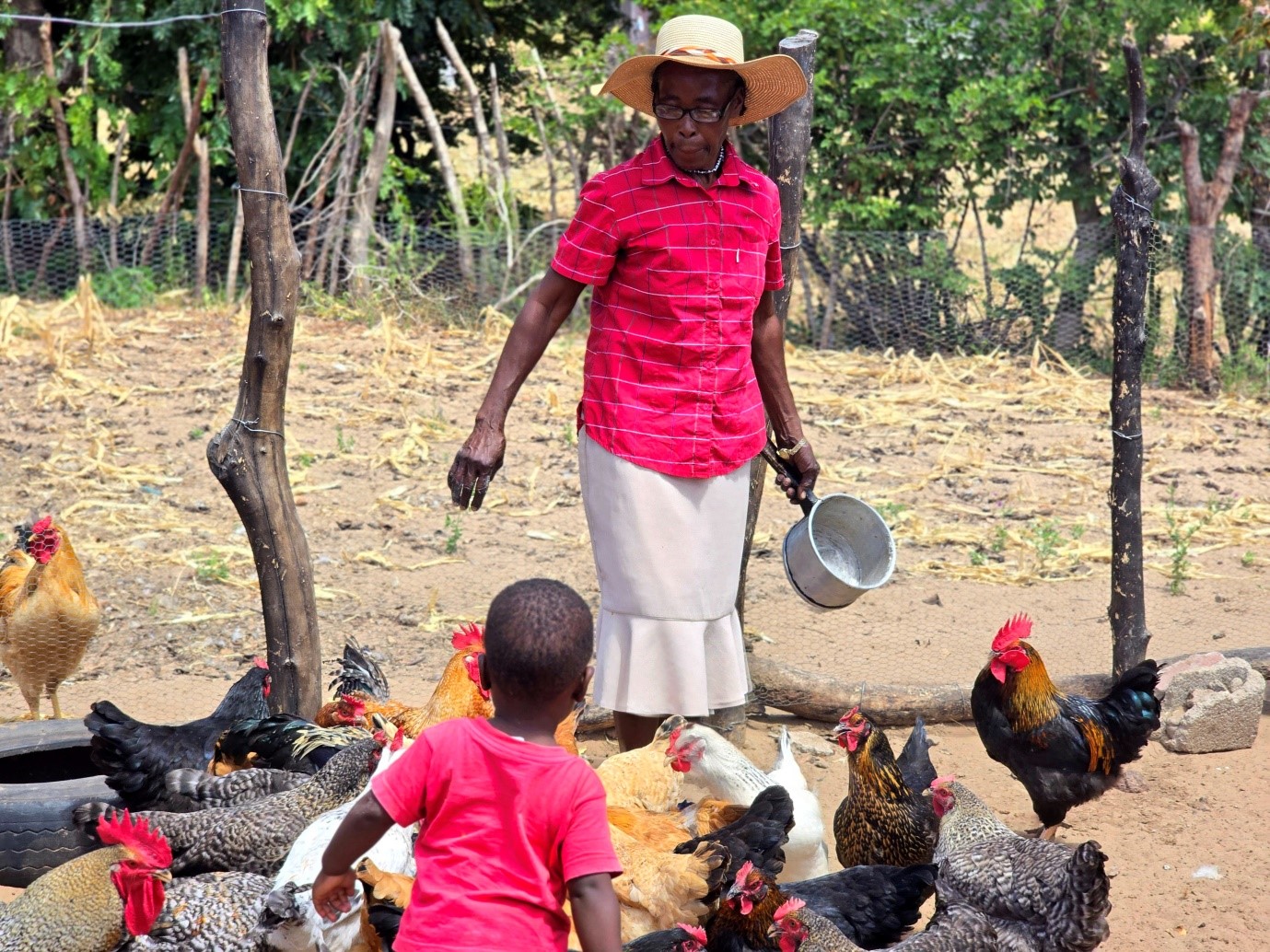
Rebecca Chiyaka is a 62 year old female who currently lives with her husband and takes care of her two year old grandchild. Before the “Building Resilience in Gokwe South communities,” Rebecca had been mainly dependent on remittances for her children and loved ones. She did not think that she could do something productive and profitable for herself and by herself.
At one point, Rebecca attempted a poultry project, rearing broilers on her own. Unfortunately, the project was not as viable as she had expected. The fowl run she had constructed was not appropriate and she had not set up the essential controls for maintaining the required phytosanitary condtions. “I did not know that my chickens also require good, clean food and water just like us humans. It is only after participating in the project that I learnt of the importance of clean water, quality feed, vaccination and ventilation for the birds.”
When asked about some of the biggest impacts that the “Building Resilience” project had on her life, Rebecca highlighted that the project taught her the importance of self-reliance and being productive as woman through the Internal Saving and Lending (ISAL) groups and Income Generating Activity (IGA) interventions. After gaining improved access to savings and credit through the ISAL groups, Rebecca purchased a peanut butter making machine. Coupled with the improved technical knowledge on poultry production, she resumed her broiler rearing project and even went on to add value by packaging the poultry meat into smaller packs of cutlets which she claimed “sold as fast as hotcakes!” Rebecca is fortunate that she has access to solar energy and hence a solar-powered refrigerator. The access to energy has been an important factor in the IGAs she has been able to individually explore.
Rebecca came to settle in Gokwe in 2015 after her husband’s retirement and she reflected on how her life has changed from then; “Before the project, I was sleeping!” Rebecca’s success has not stopped at her individual level, but she has taken up a leadership role in her group. When the project offered initial stock of improved breeds and other support in indigenous chicken production, she volunteered to host the group fowl run. She is currently taking care of this initial stock of indigenous chickens together with the other group members and when the flock matures each member will be able to access the chicks and replicate the project at their own homestead.
“When other women see me doing the various projects, some of them do not believe that they can also do it. However, working together on the indigenous chicken project, enables us to work together and they gain skills and knowledge in a practical way, and I get to share my experiences with them.” Listening to Rebecca’s soft-spoken but heartfelt story reveals that indeed she has been “empowered to empower others.” Through the interaction with Rebecca, other women especially young women have been encouraged to utilize the savings and credit from ISALs productively and not only for immediate consumption.
A visit to Rebecca’s homestead is a testament to the multifaceted nature of the project. The increased income she has been able to make has been invested in enhancing good health and hygiene. Rebecca has built a new latrine that meets the minimum standards promoted by the project. She has also been able to established a raised pot rack for improved hygiene.