
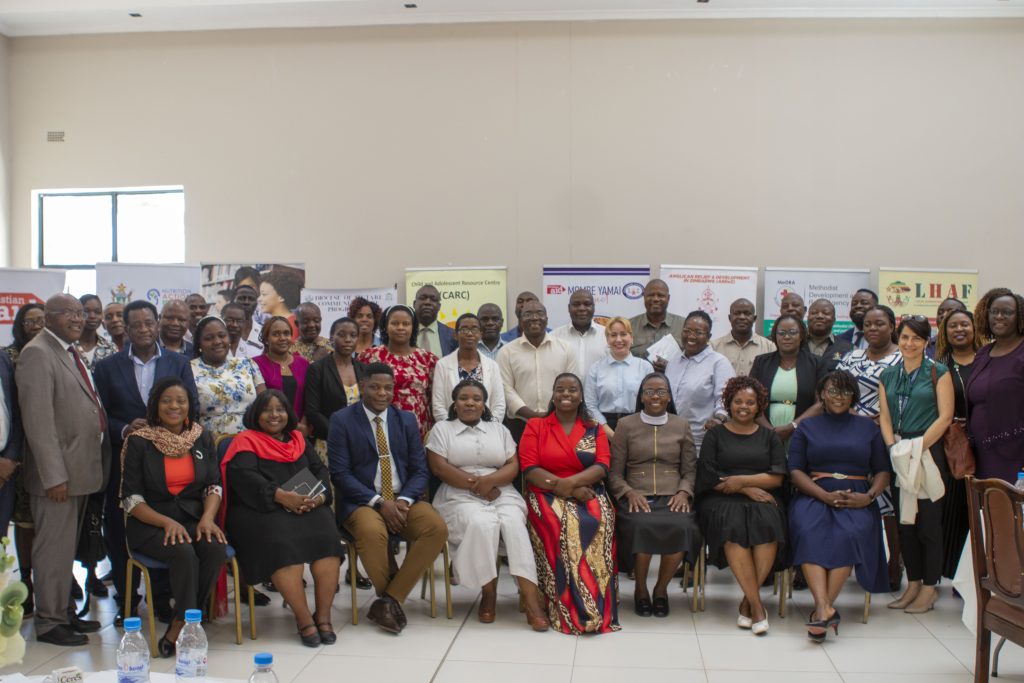
On 2 October 2025, Zimbabwe witnessed a transformative milestone in its humanitarian landscape with the official launch of the Local Humanitarian Actors Forum (LHAF) at Kentucky Hotel under the theme “Local Leadership First: Advancing Local Knowledge and Adaptive Management to Unlock and Strengthen Local Humanitarian Solutions.” The launch, chaired by communications consultant Emelda Takaona, brought together government representatives, NGOs, faith-based organisations, private sector actors, INGOs and development partners, marking the beginning of a new chapter in locally led humanitarian coordination and resilience building.
In her opening remarks, Kudzaiishe Ndawana, the National Director of the Methodist Development and Relief Agency (MeDRA) Zim, described the launch as a defining moment for Zimbabwe’s humanitarian ecosystem. She emphasised that the LHAF, supported with funding from Christian Aid, seeks to unite a diverse range of actors—government, civil society, donors, and the private sector—around a single purpose: strengthening collaboration, aligning interventions with national priorities, and advancing the global commitment to “leave no one behind.” The forum, she said, represents a shift from reactive crisis management to proactive, resilience-based humanitarian action. Through its focus on inclusivity, innovation, and local leadership, LHAF aims to ensure that every community, family, and child receives timely, effective support in times of crisis. Ndawana underscored that humanitarian challenges are too complex for any single entity to address alone, calling for a collective response that leverages the comparative strengths of each actor.
Tariro Washaya-Mpofu , MeDRA’s Programs Manager, presented the journey that led to the establishment of LHAF. She outlined the challenges local humanitarian actors face—limited resources, fragmented coordination, and recurring overlap in community interventions that have led to “beneficiary fatigue.” A self-assessment conducted by local organisations exposed gaps in capacity, knowledge, and adherence to humanitarian standards. In response, these organisations decided to form a coordinated platform to pool resources, harmonise efforts, and collectively strengthen their ability to deliver timely and effective aid. With support from partners such as Christian Aid, the initiative aims to transform Zimbabwe’s humanitarian landscape into one that is cohesive, efficient, and led by local expertise. Washaya stressed that the forum’s success depends on collaboration, mutual learning, and capacity exchange among local actors rather than top-down assistance from external entities.
A major highlight of the event was the unveiling of the LHAF Knowledge Hub, presented by Privilege Murambadoro, MeDRA’s Monitoring, Evaluation, and Learning Officer and Knowledge Hub System Administrator. Privilege demonstrated how the platform embodies the global localization agenda by shifting humanitarian power, knowledge, and leadership from international actors to local hands. The Hub is a secure, member-driven digital platform designed to empower Zimbabwe’s local humanitarian organisations by providing access to knowledge, learning opportunities, and collaborative tools. It features a curated digital library covering thematic areas such as disaster risk reduction, community engagement, emergency response, legal frameworks, monitoring and evaluation, and organisational capacity strengthening. Registered members can access self-paced courses, upload content, and share expertise. This model promotes South-to-South collaboration, where local actors share context-specific solutions and co-create knowledge that is relevant and actionable within Zimbabwe’s unique environment. Privilege emphasised that the Hub is not simply a repository but a living movement—one that fosters solidarity, innovation, and local ownership. Its governance structure, with organisation-level administrators, ensures data protection, content quality, and accountability, while its vision of co-created sector-wide mandatory courses—such as safeguarding induction—sets the stage for standardised humanitarian learning across the country.
The panel discussion, moderated by Emelda Takaona, tackled the critical question of how to strengthen local leadership for resilient, self-sustaining humanitarian interventions. Panellists Aulline Chapisa (Christian Aid Zimbabwe Country Director), Tapiwa Magaisa (Nutrition Action Zimbabwe National Director), @Maria Dendere (Zimbabwe Council of Churches), Auxilia Chikavu (Zimbabwe Women’s Microfinance Bank (ZWMB)), and Patience Chiputira (Ministry of Public Service, Labour and Social Welfare; Department of Social Development) engaged in a candid conversation on power, accountability, and decolonisation in humanitarian partnerships. They agreed that genuine localisation cannot be achieved through rhetoric alone—it requires an intentional shift in power dynamics, resource control, and decision-making authority. Chapisa noted that “power is not given; it is taken,” calling on local actors to assert leadership while INGOs commit to equitable partnerships. The panel stressed the importance of capacity exchange over traditional “capacity building,” recognising that local organisations possess valuable contextual expertise that international partners can learn from. Discussions also emphasised mutual accountability—where INGOs and local partners hold each other responsible, with communities as the ultimate arbiters of success. Government representative Patience Chiputira linked localisation and decolonisation to broader national reforms that address inequality, injustice, and colonial legacies. She outlined government efforts to revise policies and ratify international conventions that empower communities to mobilise resources and act independently, aligning humanitarian localisation with Zimbabwe’s ongoing social and legislative transformation.
The forum’s momentum culminated in the official launch of LHAF, marked by a keynote address from Mr Farai Hokonya, Deputy Director of Civil Protection, on behalf of the Chief Director of Civil Protection, Mr N. Nkomo. In his remarks, Hokonya praised MeDRA for its leadership in strengthening community-led development through faith-based engagement and humanitarian coordination. He reaffirmed the government’s support for the LHAF as a multisectoral platform that complements Zimbabwe’s Vision 2030, National Development Strategies (NDS1 and NDS2), and the UN Sustainable Development Goals. Hokonya underscored that the forum’s integration with government structures ensures that humanitarian action is coordinated, transparent, and legally compliant under the Civil Protection Act. He further highlighted government investments in inclusive disaster risk management, including the establishment of the National Disaster Management Centre, the ZIMDRIMS system, and a new Disaster Risk Management mobile application designed to improve early warning and rapid response. The Deputy Director called for all humanitarian stakeholders to expand the LHAF across provinces, turning it into a nationwide network that promotes preparedness, accountability, and resilience. He reiterated the importance of data-driven decision-making, gender and disability inclusion, and adherence to legal frameworks, positioning LHAF as a key partner in national disaster management systems.
The meeting closed with a strong sense of purpose and unity. Participants committed to concrete action points, including populating the Knowledge Hub with organisational profiles and tools, adopting staff care policies, finalising the localisation charter, and sustaining the conversation on power, partnership, and policy reform. The day’s exchanges captured a shared understanding that Zimbabwe’s humanitarian effectiveness depends not on external interventions but on empowering local systems, knowledge, and leadership.
The Local Humanitarian Actors Forum represents more than an organisational network—it is a movement redefining humanitarian action in Zimbabwe. Through its focus on local empowerment, collaboration, and knowledge sharing, LHAF positions Zimbabwe at the forefront of Africa’s localisation agenda. By connecting government frameworks, community initiatives, and digital innovation, the forum ensures that humanitarian response becomes not just faster and more effective, but also fairer and more inclusive. As the country confronts growing climate-related challenges—floods, droughts, and displacement—LHAF stands as a testament to what can be achieved when local leadership, faith, and shared vision come together. Its launch marks not an end, but a beginning: a commitment to build a stronger, more resilient, and self-reliant humanitarian ecosystem where local actors lead, communities thrive, and no one is left behind.